Matching gifts are one of the most powerful (albeit underutilized) funding sources available to nonprofits and schools today. Yet according to Double the Donation, an estimated $4 to $7 billion in corporate revenue goes unclaimed every year. And while 26+ million individuals work for companies with matching gift programs, over 78% have no idea their employer offers this benefit.
Optimizing your online presence unlocks vital corporate revenue, with your website serving as the digital ‘front door’ that converts donor intent into matched funding. If your nonprofit’s website isn’t doing that, make sure you’re not falling into one of these critical traps:
- Your matching gift content is hidden in the footers.
- Overcomplicated submission steps discourage action.
- Volunteer programs are siloed from corporate dollars.
- Your approach lacks personalization and timely stewardship.
- Your web content isn’t getting online traffic at all.
After exploring each of these roadblocks (along with our actionable suggestions for overcoming them), we’ll also walk you through a sample matching gift web page that aligns with modern donor expectations, so your team can see what others are doing well.
Reason #1: Your matching gift content is hidden in the footers.
Donors rarely hunt through obscure submenus or site footers to discover if their employers will match their contributions. When corporate giving options are invisible during the primary decision-making moment, donor participation drops significantly.
The solution: Prominently display relevant information and resources.
Don’t bury workplace giving links in tiny footer text. Rather, create a dedicated landing page for matching gifts, and link to it directly within your site’s primary navigation menu.
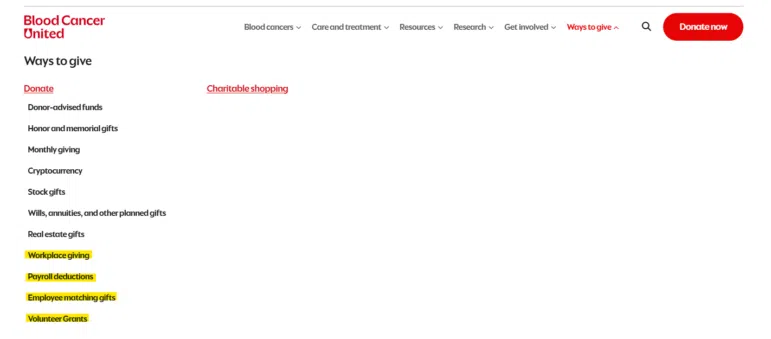
Then, ensure the resource clearly explains matching gift program guidelines, illustrates the benefits of workplace matching programs, and offers helpful search tools so donors can check their eligibility status in seconds.
Reason #2: Overcomplicated submission steps discourage action.
Donors expect digital transactions to be quick, clear, and intuitive. If claiming a match requires searching through corporate intranets or filling out complex paper forms, supporters will drop off before completing the request.
The solution: Eliminate technical friction at checkout.
The moment immediately following a donation is when supporter enthusiasm is highest. Capitalize on this window by embedding an employer data field directly within your donation page and providing direct links to the appropriate request forms on your confirmation screen.
This allows organizations to capture corporate affiliations at the point of heightened donor engagement, making it easy to trigger tailored follow-ups (which instantly eliminate the research barrier) immediately after gifts are processed.
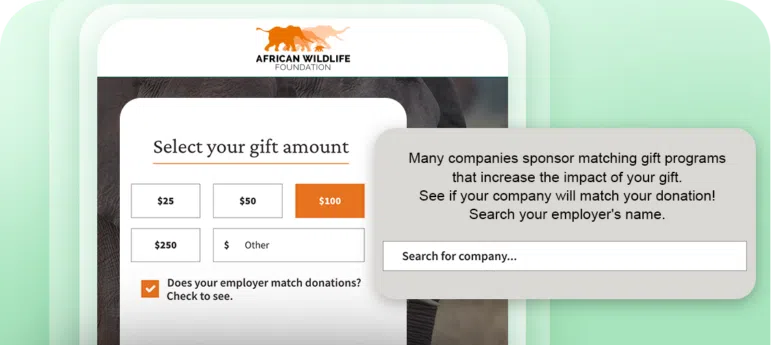
Not to mention, modern workplace giving software allows eligible employees to complete their matching gift requests directly from the nonprofit’s donation form with a single click. By removing the need to access external portals and manual paperwork, auto-submission functionality drastically increases completion rates.
Reason #3: Volunteer programs are siloed from corporate dollars.
Corporate support extends beyond monetary gifts. If your volunteer-focused resources pages treat service hours purely as manual labor rather than potential revenue opportunities, you’re likely leaving significant funding on the table.
The solution: Proactively market ‘Dollars for Doers’ programs.
Thousands of companies (including ExxonMobil, Microsoft, Disney, and more) contribute financial grants or ‘Dollars for Doers’ to nonprofits and schools where their employees regularly volunteer. But, like traditional matching gifts, organizations must take a proactive approach to increasing program awareness.
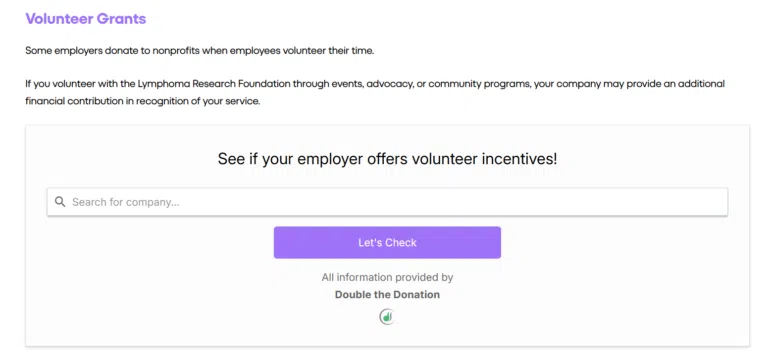
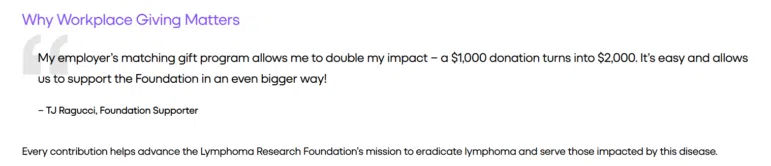
For the best results, we recommend adding an intuitive employer search field to your volunteer information and registration forms. Here’s an example from the Lymphoma Research Foundation’s website:
Reason #4: Your approach lacks personalization and impact stories.
A generic receipt often fails to inspire long-term loyalty or prompt immediate follow-through on employee giving program participation. Unlocking continuous corporate funding requires organizations to take a more personalized stewardship approach that validates donor impact.
The solution: Tell compelling, impact-driven stories.
According to a 2026 Nonprofit Corporate Engagement report, nearly 58% of surveyed fundraisers indicated that stories about impact generate the most engagement in workplace giving communications. Therefore, if you’re looking to inspire involvement in corporate philanthropy programs, demonstrating exactly how those funds affect your organization’s mission can go a long way.
Check out a few examples here, then determine which kinds of stories would best reflect your social impact focus:
- “Your matched $100 donation provides an entire month of after-school tutoring materials for an at-risk student in our community.”
- “When John Doe had his generous contribution matched by his employer, the extra funds provided nutritious groceries for another family in need.”
Donors tend to respond well to tangible proof of their impact, so use graphics and simple copy to illustrate how corporate matching multiplies their support.
Reason #5: Your web content isn’t getting online traffic at all.
Many nonprofits make the mistake of creating a matching gift page and expecting donors to discover it organically. In reality, driving corporate revenue requires a proactive matching gift promotion strategy that continuously directs supporters to cross-channel workplace giving resources. After all, even the most seamless, detailed matching gift web experience will fail to generate revenue if supporters never visit the page.
The solution: Implement a proactive linking strategy.
Rather than treating workplace giving as an isolated topic, integrate matching gift information within your regular communication cadence. For example, we recommend adding a P.S. line to any upcoming fundraising appeals, donation receipts, digital newsletters, and year-end impact reports. Then, invite donors to check their matching gift eligibility by providing a direct link to your landing page!
From there, social media provides another dynamic channel for educating supporters and driving inbound site traffic.
Another solution: Optimize for SEO to capture organic intent.
Search engine optimization (or SEO) ensures that your matching gift content ranks highly when interested donors search for information online.
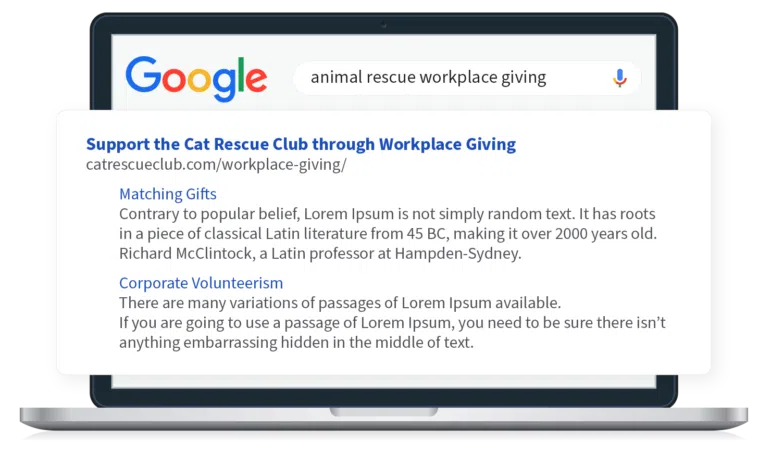
Incorporating high-intent search terms like “company gift matching,” “does my employer match donations,” or “workplace giving” into your page title, H2 headings, and meta descriptions helps search engines understand your content, making it easier for supporters to locate the details they need to get involved.
Another solution: Tap into Google Ad Grants for dedicated search traffic.
Google’s Ad Grant program provides eligible nonprofits and schools with up to $10,000 per month in free search advertising credits.
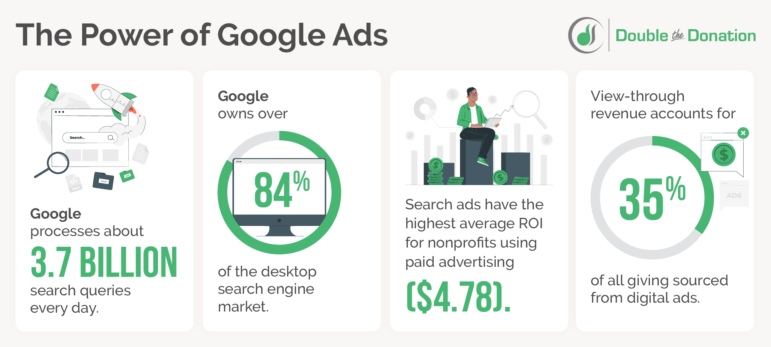
Bidding on matching gift-related keywords allows your nonprofit’s matching gift content to appear at the top of Google results (above organically ranking materials) when supporters search for relevant terms.
Bonus: Explore Penny Appeal USA’s matching gift web page.
Sometimes, the best way to gain inspiration for your own marketing efforts is to take a look at what peer organizations are doing well. And lucky for you, Penny Appeal USA offers an exceptional blueprint for a well-structured matching gift page.
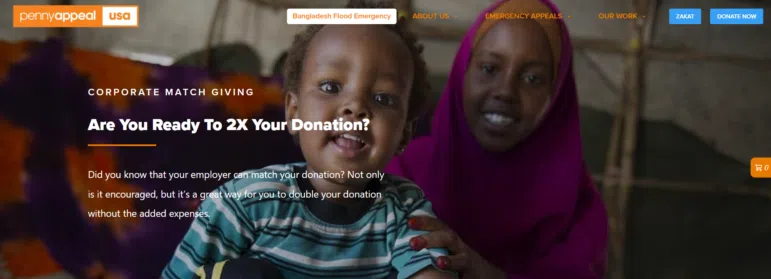
This resource aims to eliminate guesswork among interested supporters, actively guide donors through the request process, and expand employee-led philanthropy into multiple workplace channels.
Clear, easy step-by-step process
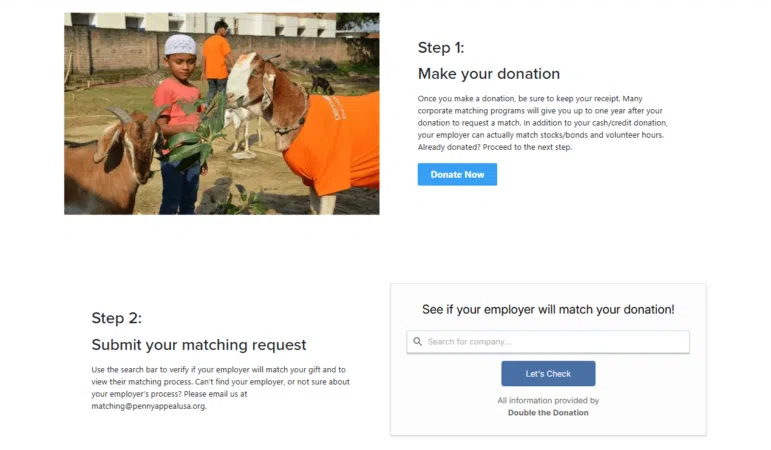
Penny Appeals USA’s dedicated match page breaks the donor journey down into simple, numbered steps. Rather than overwhelming supporters with lengthy corporate requirements, the digital hub outlines a clear sequence: 1) make your donation, 2) submit your request, and 3) verify the match.
This straightforward breakdown removes cognitive overload, giving supporters a quick road map to complete their submission.
Embedded company search tool
Central to the layout is an embedded company search tool. Donors can search for their employer directly on the page to surface company-specific eligibility criteria, submission deadlines, and direct links to their HR portals in real time.
By eliminating the need for donors to conduct extensive external research, Penny Appeal USA drastically reduces submission drop-off rates.
Intuitive “I’ve Submitted My Match” call to action
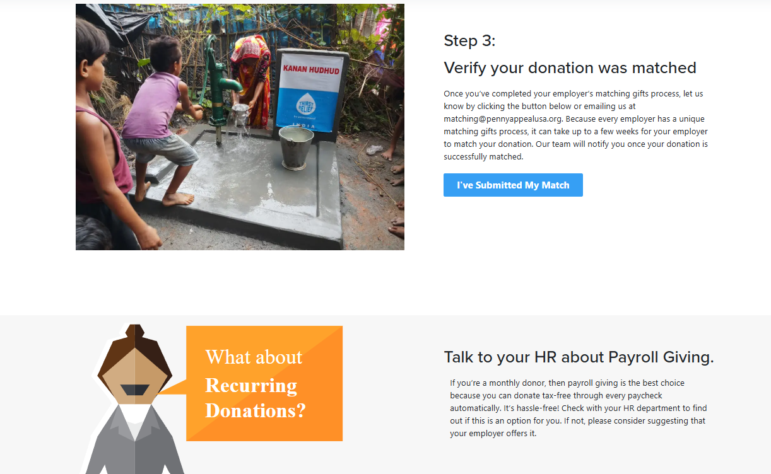
A unique element on Penny Appeal USA’s verification section is a bright, prominent “I’ve Submitted My Match” button. When clicked, the CTA (call to action) triggers a status update to the organization’s matching gift email address, bridging the communication gap between the donor’s action and the nonprofit’s internal tracking.
This allows donors to easily notify the organization’s fundraising team, letting them know to expect incoming corporate funds and ensuring accurate pipeline tracking.
Next Steps for Your Nonprofit Website
Transforming your website into a high-converting corporate fundraising engine does not require a complete overhaul. By simplifying the process with donor-facing search tools, eliminating submission friction, and connecting volunteer hours to corporate giving opportunities, organizations can easily bridge the awareness gap for their supporters.
Ready to bring your digital fundraising to new heights? Audit the exact journey a supporter takes through your website today, then streamline your follow-up touchpoints and begin capturing the corporate matches your mission deserves.
Good luck!