Picture this: You just built a beautiful website to showcase your mission, but without a strategic approach to increase your search engine presence, all that hard work remains invisible to potential donors and volunteers. What do you do?
To ensure your cause gets the attention it deserves, you need to take steps to help people actually find your website. Search engine optimization (SEO) is your ultimate weapon here!
By mastering the fundamentals and best practices of SEO for nonprofits, you can drive sustainable traffic to your cause without relying solely on paid advertising. This guide demystifies the technical jargon, offering a practical playbook designed to turn your website into a powerful engine for organic growth. Here’s what you’ll learn:
- What Does SEO for Nonprofits Mean?
- Why SEO Matters for Nonprofits
- Key SEO Strategies for Nonprofit Websites
- Essential SEO Tools for Nonprofits
- Unethical Nonprofit SEO Practices to Avoid
- How Cornershop Creative Helps With SEO for Nonprofits
Let’s transform your website from a static brochure into your organization’s ultimate digital engagement hub.
Stop guessing. Start ranking.
Let Cornershop Creative drive your nonprofit SEO strategy!
What Does SEO for Nonprofits Mean?
SEO for nonprofits is the practice of optimizing an organization’s website to rank higher in organic search results. Effective nonprofit SEO relies on these elements:
- Keyword research: Identifying high-value search terms related to your mission.
- On-page optimization: Refining meta descriptions, headers, and content to match user intent.
- Backlink building: Acquiring high-quality backlinks from reputable sites.
- Technical SEO: Ensuring the site is technically sound for users and search crawlers.
For example, if you were to type “volunteer at NYC animal shelter” into Google, you would see a list of web pages to choose from:
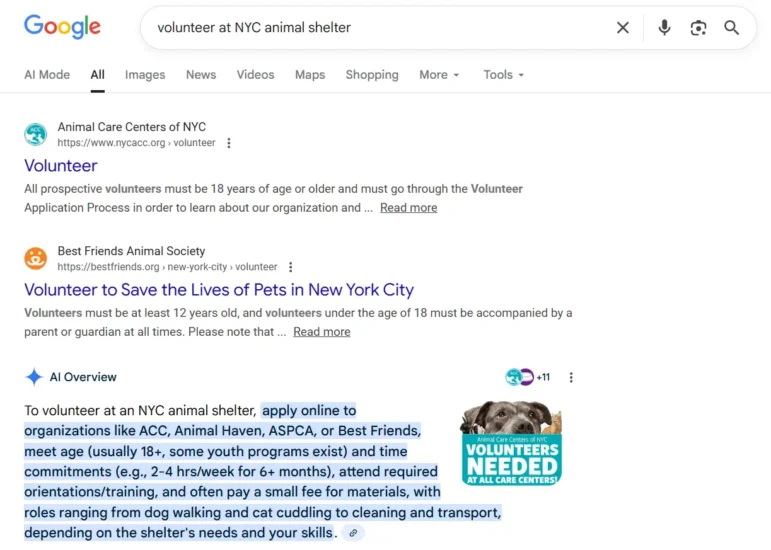
Among these results, you’re likely to pay the most attention to (and click on) the pages at the top of the search results list. According to Backlinko, the number one result has an average click-through rate of 27.6%.
On today’s search engine results pages (SERPs), you’ll also notice an AI overview, which parses information from optimized pages and summarizes it for users. The growing prevalence of AI overviews makes optimized headings and high-quality content even more essential for visibility.
How Search Engines Read Your Nonprofit’s Website
While search engines like Google use complex, secretive formulas to determine results, the actual mechanics of how they read your site come down to three distinct steps:
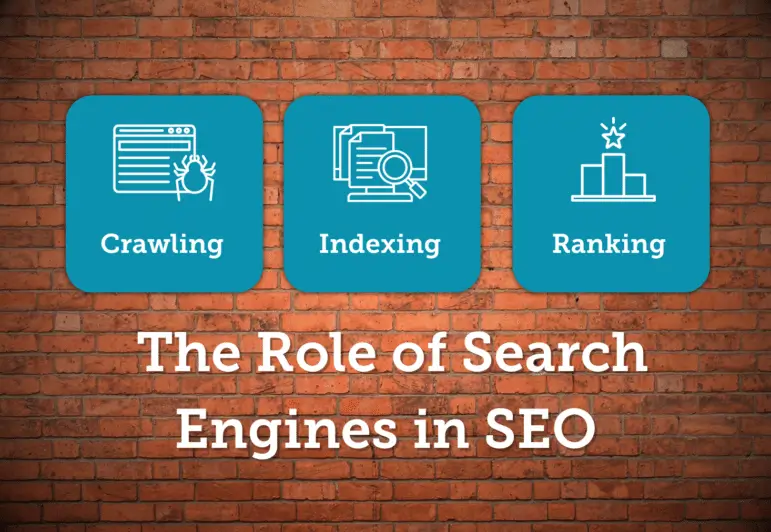
- Crawling: This is the discovery phase. Search engine bots (often called “spiders” or “crawlers”) constantly scan the internet to find new or updated pages. They download your content (text, images, and videos) to see what exists on your site.
- Indexing: Once found, the search engine analyzes the content to understand what it is about. If the page is deemed valuable and valid, it is stored in a massive index, making it eligible to show up in search results.
- Ranking: When a user types a query, algorithms instantly sift through the index to find the best answers. They rank these pages based on hundreds of factors—including relevance, authority, and user experience—to decide which ones appear at the top of the results page. Rankings change over time as websites update their content, optimize their technical aspects, and secure authoritative backlinks from other sites.
Understanding this process helps you see why technical health is just as important as good content for nonprofit SEO.
Key Factors That Search Engines Look For When Ranking Content
Search engines like Google are designed to review hundreds of factors when crawling and ranking pages. While search engine providers don’t publicly list these factors, what they have revealed, paired with what SEO researchers have discovered, gives us a pretty good idea of how to create strong content for your mission!
Here are a few elements that can have a dramatic impact on your nonprofit’s SEO performance:
- Content Relevance: Alignment with the user’s specific search intent (informational vs. transactional)
- Keyword Usage: Natural inclusion of search terms in titles, headers, and body copy
- Mobile Usability: Seamless experience on smartphones and tablets
- Page Speed: Fast loading times to reduce bounce rates and improve user retention
- Secure Connection (HTTPS): Encrypted connection ensuring visitor safety and data protection
- Backlinks: Inbound links from reputable sites acting as votes of confidence
- Internal Linking: Logical connections between your own pages to guide users and crawlers
- User Experience (UX): Positive engagement signals, such as easy navigation and low bounce rates
- Meta Tags: Descriptive titles and summaries that encourage users to click from search results
- Image Alt Text: Text descriptions of images that improve accessibility for screen readers and bots
- URL Structure: Short, descriptive web addresses that are easy to read
Nonprofit SEO is in our DNA.
Work with a team that knows how to amplify your cause.
Why SEO Matters for Nonprofits
Implementing a strong nonprofit SEO strategy requires time and technical effort, which may leave you wondering: Is it really worth the investment?
The short answer is yes. While social media and email marketing are essential for engaging your current audience, SEO is the primary engine for organic digital growth. It connects you with people who care about your cause but don’t know you exist yet. Specifically, a dedicated SEO strategy delivers high-impact benefits that other channels cannot match:
- Cost-Effectiveness: Delivers sustained organic traffic without the recurring costs of paid advertising.
- Increased Visibility and Support: Ensures donors, volunteers, and beneficiaries can easily find your mission online.
- Authority Building: Positions your organization as a reliable, trusted source in your sector.
- Driving Action: Targets high-intent users to convert passive traffic into active supporters.
Pro Tip: SEO also complements your existing marketing channels. Let’s say that you already send out a monthly email newsletter and post regularly on Facebook and Instagram. SEO can fit in nicely with these strategies as you share high-quality website content in your newsletter and across your social profiles. Also, if you run paid ads with the Google Ad Grant, ranking organically for other keywords increases your visibility and reinforces your message.
Key SEO Strategies for Nonprofit Websites
Creating high-ranking content requires a dual focus: satisfying Google’s algorithms while inspiring your human readers. We have compiled the top nonprofit SEO best practices to help you achieve both goals simultaneously.
Want to test your knowledge of SEO best practices? See if you can spot the differences between good and poor strategies:
1. Conduct Effective Keyword Research
Keywords are the bridge between your organization and your future supporters. To get noticed, you need to identify exactly what terms people are typing into Google when looking for your mission. These are your keywords.
Here are some tips for finding the right ones to target:
- Use keyword research tools. Use data to drive your decisions. Free resources like Ryan Robinson’s keyword tool are great for starting out, but as your nonprofit SEO strategy matures, advanced tools like Moz or Semrush provide critical data on monthly search volume and ranking difficulty. You should also analyze similar organizations to see what keywords they rank for and reveal strategy gaps.
- Get specific with long-tail keywords. Newcomers often target broad terms, but a keyword like “grassroots activism” puts you in direct competition with giants like Wikipedia and government sites. Instead, target long-tail keywords: specific phrases with lower search volume but higher relevance.
- Too Broad: “Grassroots activism”
- Just Right: “Environmental grassroots movements in Boston”
- Understand the search intent behind keywords. When researching keywords, pay close attention to the content that currently ranks. What are users trying to accomplish when visiting those pages?
- Informational Intent: Someone searching “benefits of adopting a pet” is looking to learn. Direct them to a blog post.
- Transactional Intent: Someone searching “donate to animal shelter NYC” is ready to act. Direct them to your donation page or a fundraising campaign page.
Mastering these keyword research strategies ensures you’re connecting with the specific audience most likely to support your mission.
2. Create High-Quality, Optimized Content.
Once you have your target keywords, you need to create content that provides genuine value. You don’t need to optimize every single page on your site. Instead, prioritize high-value assets like donation landing pages, program pages, and educational blog posts that directly answer user questions.
Remember, SEO for nonprofits is about playing the long game. Rarely will you see results overnight, so choose content to optimize that aligns with your long-term goals and priorities.
For example, an animal shelter’s blog post on “The Benefits of Adopting vs. Shopping” would be a prime candidate for optimization because it educates users while guiding them toward the organization’s mission.
To balance readability for humans with optimization for bots, try these nonprofit SEO strategies:
- Write for the reader first. Search engines have evolved to prioritize content that is helpful, informative, and keeps users on the page. Focus on answering your visitors’ most pressing questions thoroughly rather than just trying to hit a word count.
- Integrate keywords naturally. Google is sophisticated enough to understand context. If your keyword is “volunteer opportunities,” use it where it makes grammatical sense, and use natural variations (like “ways to help” or “volunteering”) throughout the text.
- Prioritize readability. Online readers skim. Make your content digestible by writing short paragraphs (around 2-3 sentences) and using clear, direct language. If a user sees a wall of text, they will likely leave, signaling to Google that your content wasn’t helpful.
Ultimately, the best way to signal value to a search engine is to provide a helpful, engaging experience for the human behind the screen.
3. Follow On-Page Optimization Best Practices.
Writing great content is a solid start. When it comes to SEO for nonprofits, you need a clear structure for your content, too. Even the most persuasive fundraising appeal can be missed if the page isn’t labeled correctly for Google.
Most content management systems (CMS) like WordPress have built-in tools or plugins (like Yoast SEO) to help you prepare your web pages to be understood by both search engines and humans. Use those tools to refine the following elements:
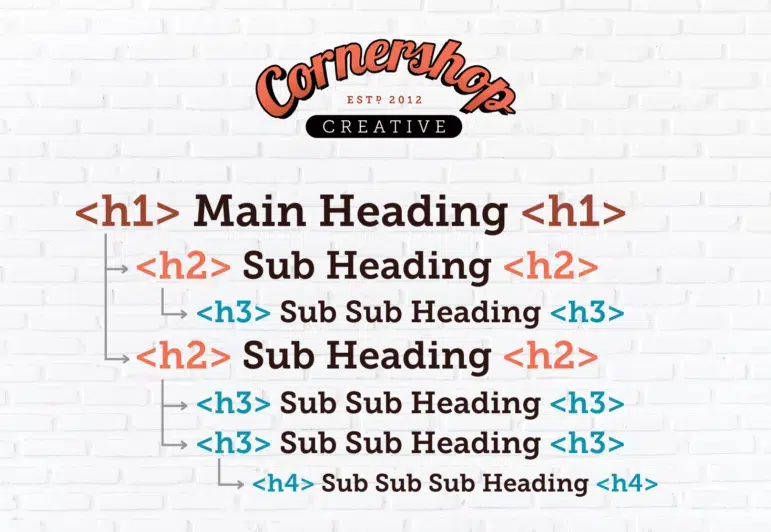
- Clear Heading Hierarchy: Use header tags (H1, H2, H3) to outline your content. Your page’s main title should be an H1, while main points are H2s. This code structure helps search bots understand the importance of each section and makes your content accessible to screen readers. Here’s an example of what this looks like:
- Optimized Title Tags: This is the headline that appears in search results, making it an incredibly important on-page SEO factor. Keep it under 60 characters and place your primary keyword near the beginning to signal relevance.
- Image Alt Text: Search engines cannot “see” images. They read the text attached to them. Add descriptive alt text to your images. This improves accessibility for visually impaired users and helps your images rank in Google Image Search.
- Compelling Meta Descriptions: This short summary (under 160 characters) acts as your copy on the search results page. A persuasive meta description that matches the user’s intent will improve your click-through rate.
- Clean URL Slugs: Avoid default URLs like /page?id=452. Instead, create short, descriptive URLs that include your keyword, such as /volunteer-opportunities or /annual-report-2026.
4. Focus on Technical SEO and Site Performance.
For your content to rank highly, your nonprofit’s website must be technically sound and offer seamless functionality. This foundation is known as technical SEO, and it includes:
- Website Speed: Ensuring pages load quickly to prevent drop-offs
- Mobile Friendliness: Providing a responsive design for smartphone users
- Security: Using a secure connection (SSL and HTTPS) to protect user data
- Sitemaps: Creating and submitting a sitemap to help Google find your pages
- Robots.txt: Using your robots.txt file to guide search crawlers to the right content
- Link Health: Fixing broken links and managing redirects
- Internal Linking: Connecting your pages to improve site navigation
While you can tackle many of these updates on your own with a bit of research, technical SEO can be complex. You may find it more efficient to outsource this work to a nonprofit web design agency that specializes in technical optimization.
5. Improve the User Experience (UX) of Your Nonprofit Website.
Search engines don’t just scan code; they measure how humans interact with your page. If users arrive at your site and immediately leave because they are confused (AKA “bounce”), Google assumes your content wasn’t helpful. Therefore, great UX is great SEO for nonprofits.
To keep visitors engaged and exploring your mission:
- Balance visuals with speed. Text-heavy pages can feel like homework. Use high-quality photos and infographics to keep potential donors engaged. However, don’t let visuals slow you down. Large images are the main culprit of slow load times, so use tools like TinyPNG to compress images and reduce file sizes below 1MB. You can also use our Media Deduper WordPress plugin to remove unused duplicate images that weigh down your server.
- Create interactive elements. Features like impact maps, quizzes, or donation calculators encourage visitors to stop scrolling and click. This increases the time users spend on your page (dwell time), signaling to Google that your content is valuable.
- Refine your navigation menu. Nonprofit websites often evolve organically, leading to cluttered menus and muddled content categories. Regularly audit your main menu to ensure it reflects your current priorities. Remove outdated pages and ensure that visitors can find your donation form or volunteer sign-up page within seconds of landing on the site. Check out this example from Oceana, which features an organized menu containing content and clear call-to-action (CTA) buttons:
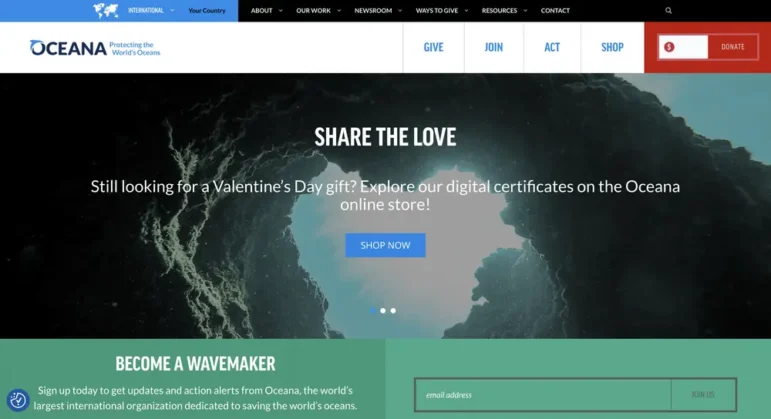
You don’t need expensive software to test usability. Ask a volunteer who is unfamiliar with your website to complete specific tasks, such as making a refundable donation or finding your annual report. Ask them to narrate their thoughts aloud as they browse. Hearing them say, “I’m looking for the donate button, but I can’t find it,” provides actionable feedback.
6. Create A Strong Link Building Strategy.
Think of links as the reputation and roadmap of your website. Search engines use them to figure out how trustworthy your content is and how your pages relate to one another. To build a healthy backlink profile, focus on connections both inside and outside your domain.
First, prioritize internal linking (connecting your own pages to one another). As one of the most basic SEO strategies for nonprofits, this creates a web of content that keeps visitors engaged. For example, if a user is reading a blog post about your literacy program, don’t let them hit a dead end. Instead, link them directly to your volunteer mentor signup page. This not only guides the user toward action but also helps Google’s crawlers discover new pages and understand your site’s structure.
Second, treat backlinks and external/outbound links like social networking:
- Inbound (Backlinks): When a reputable site (like a partner organization or local news outlet) links to you, it signals to Google that you are an authority worth ranking.
- Outbound: Don’t be afraid to link out to high-quality sources, either. Just as you are judged by the company you keep, linking to reputable research or government data lends your content credibility.
Ultimately, if your website is associated with another website that Google has deemed high quality, then linking between the sites benefits both of you.
7. Optimize Your Nonprofit’s Site for Mobile Devices.
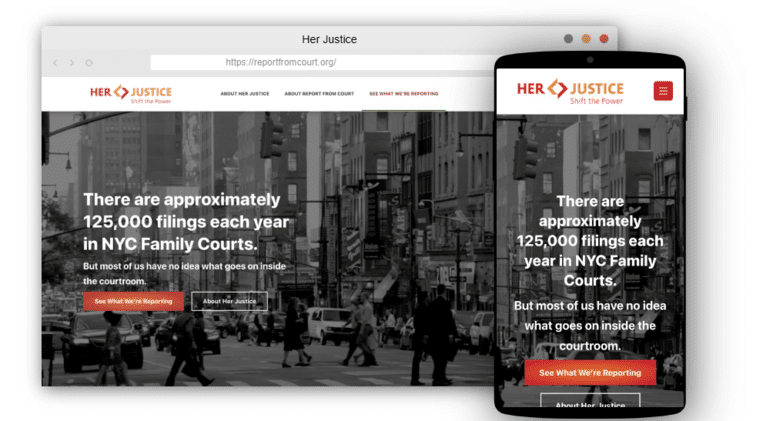
Did you know that more than 60% of website traffic comes from mobile devices? This means you need to be conscious of your mobile site’s SEO in addition to your main website.
For the most part, the mobile and desktop versions of your website should have near-identical page rankings with one major differentiating factor: mobile optimization. Google has previously rolled out updates that rewarded websites that were optimized for mobile by boosting their rankings.
Check to make sure your CMS supports mobile-responsive design and can generate mobile-friendly versions of your page. Fortunately, most modern website builders do this automatically, though some available themes may not. Make sure to preview potential themes on both desktop and mobile to find a solution that will support your mobile optimization efforts.
8. Leverage Local SEO.
Have you ever searched for “pizza” or “cafes” and noticed a map immediately pops up with nearby options? That is local SEO in action. Search results vary by the user’s location, and your nonprofit can attract more local supporters by ensuring Google knows exactly where you are.
Local visibility is a vital component of successful SEO for nonprofits. The most effective way to tap into this is by claiming and optimizing your Google Business Profile. This free listing puts your organization on Google Maps and makes you eligible for the highlighted map results.
To make the most of your profile:
- Verify your contact details. Ensure your nonprofit’s name, address, and phone number match exactly what is listed on your website.
- Add visuals. Upload photos of your facility, events, and volunteers in action to signal to Google and users that your organization is active.
- Collect reviews. Encourage happy volunteers and donors to leave positive reviews. This adds social proof and signals to the algorithm that you are a trusted community entity.
By securing your spot on the map, you ensure your community can find you when they are ready to help and beneficiaries can find you when they need help.
Essential SEO Tools for Nonprofits
There are several tools that can help your organization streamline its SEO efforts. Here are a few to consider working into your tech stack:
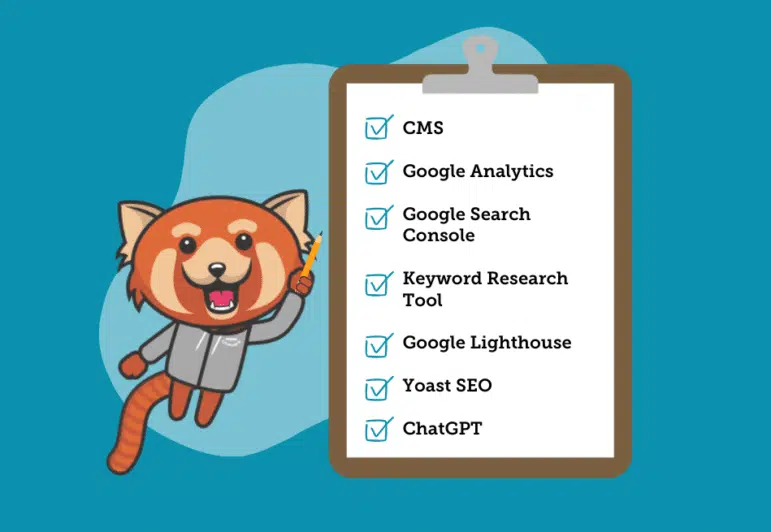
- A content management system (CMS), also known as a website builder, to create and maintain a high-quality website
- Google Analytics, which can help you track website traffic, user behavior, and conversions to monitor your nonprofit SEO success
- Google Search Console, which can help monitor site indexing and search queries, highlighting potential SEO issues with your website or specific pages
- Semrush, Moz, or Ahrefs for conducting keyword research and backlink analysis
- Google Lighthouse, which can identify issues with website performance, accessibility, and SEO and suggest general improvements
- Yoast SEO, a WordPress plugin that can help you optimize your content for search engines by assessing page readability and encouraging strong meta descriptions and meta titles
- Generative AI (ChatGPT, Gemini, etc.) to help you brainstorm keyword ideas, analyze generative engine optimization (GEO) opportunities, and create content outlines (note that you shouldn’t rely on generative AI tools to create SEO content for you)
Note that some of these tools are free (such as Google Analytics) or have free versions (such as ChatGPT), while others will require you to pay a subscription to get the most out of them for your nonprofit’s SEO efforts. Do your research and consider your budget before investing.
Unethical Nonprofit SEO Practices to Avoid
The exact formula Google uses to rank web pages is kept secret to prevent individuals from trying to cheat the system and create content with minimal value but high optimization scores. To discourage cheating, the algorithm actively penalizes websites that use unethical tactics.
While shortcuts might be tempting, this will ultimately hurt your nonprofit’s visibility. To prevent this scenario, avoid these negative nonprofit SEO tactics:
- Keyword Stuffing: Avoid cramming a keyword into your text unnaturally to the point where it becomes unreadable, a tactic known as keyword stuffing. Google prefers natural, high-quality writing and penalizes gibberish.
- Invisible Keywords: Don’t hide keywords by making the text color match the background (e.g., white text on a white background). Search engines easily detect this trick and will penalize your site for it.
- Linking Schemes: Buying links or participating in spammy link exchange networks to artificially inflate your authority is bad for your nonprofit’s SEO. Focus on earning links from reputable sources instead.
The Bottom Line: Unethical SEO practices result in content of limited value. Even if they temporarily drive traffic, visitors will likely leave immediately (increasing your bounce rate), which signals to Google that your site offers no real value.
How Cornershop Creative Helps With SEO for Nonprofits
You can certainly get started with SEO for nonprofits on your own, but let’s be honest: you are likely already wearing multiple other hats. Trying to keep up with Google’s algorithm changes while running a nonprofit can quickly feel overwhelming.
That’s where we come in! At Cornershop Creative, we understand the unique world of nonprofit work and web design. We act as an extension of your team, handling the technical details so you can focus on your mission.
Here is how we translate complex nonprofit SEO tasks into results for your organization:
- Strategic Content That Connects: We use data-driven keyword research to find the exact terms your supporters use, then help you craft engaging content that answers their questions and inspires action.
- Technical Peace of Mind: We handle the heavy lifting—from technical audits to on-page optimization—ensuring your site is fast, mobile-friendly, and error-free without you needing to touch a line of code.
- Future-Proof Visibility: Search is evolving rapidly. We implement generative engine optimization (GEO) strategies to help your nonprofit show up not just in traditional search results, but in the AI-powered answers generated by tools like ChatGPT and Gemini.
- Building Your Authority: You have a reputation to maintain. We help you earn trust online through ethical link-building campaigns that connect your site with other reputable organizations and communities.
- Clear, Actionable Insights: No confusing jargon. We provide transparent reporting that shows you exactly how our work is translating into traffic, engagement, and mission impact.
Don’t let your mission get lost on the second page of Google. Let’s work together to amplify your voice, expand your reach, and ensure your supporters and beneficiaries can find you when it matters most.
Ready to get found?
You focus on your mission’s work, and we’ll make sure the world sees it.
An Example of Our Work In Action
Don’t just take our word for it! We have a full portfolio, showcasing some of our work for world-changing organizations like yours.
Here’s a real-world example: Kitchens for Good is a San Diego-based nonprofit that seeks to transform the lives of individuals facing barriers to employment by providing apprenticeship programs focused on the culinary arts, baking, and hospitality.
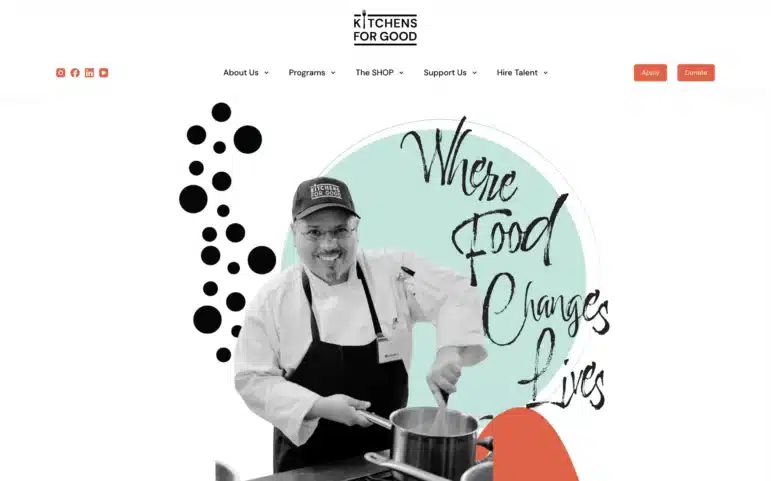
We worked with Kitchen for Goods to build them a brand new website with a fresh look and information structure. After the site launched, Kitchens for Good worked with us to use SEO (as well as Google Ads) to increase site traffic, online store sales, and class registration.
We began by conducting an SEO audit of the site and then developing our strategy, which included optimizing the organization’s key web pages with new keyword-rich copy.
After six months, Kitchen for Goods saw:
- A 20% boost in organic traffic
- A 50% increase in the number of their keyword-optimized pages ranking in the top 10 results on relevant SERPs
Want to dig deeper into this story?
Wrapping Up: Resources for Your Nonprofit’s SEO Growth
As you begin implementing these changes, remember that SEO for nonprofits is a marathon, not a sprint. It shouldn’t be viewed as a quick fix, but rather as an ongoing commitment to growing your digital presence alongside your mission.
Tracking keywords, earning backlinks, and keeping your content fresh are all necessary steps to climb the rankings. Remember, results won’t happen overnight, so stay patient and focus on creating high-quality content that your supporters actually want to read and share.
Effective nonprofit SEO doesn’t need to be complicated—it just needs to be consistent. To learn more about how you can leverage your website to reach a wider audience, check out these resources:
- Nonprofit Website Maintenance: How To Keep Your Site Fresh
- 35+ Best Nonprofit Websites: Spark Your Org’s Inspiration
- 20+ Best WordPress Support Services: Explore Your Options